
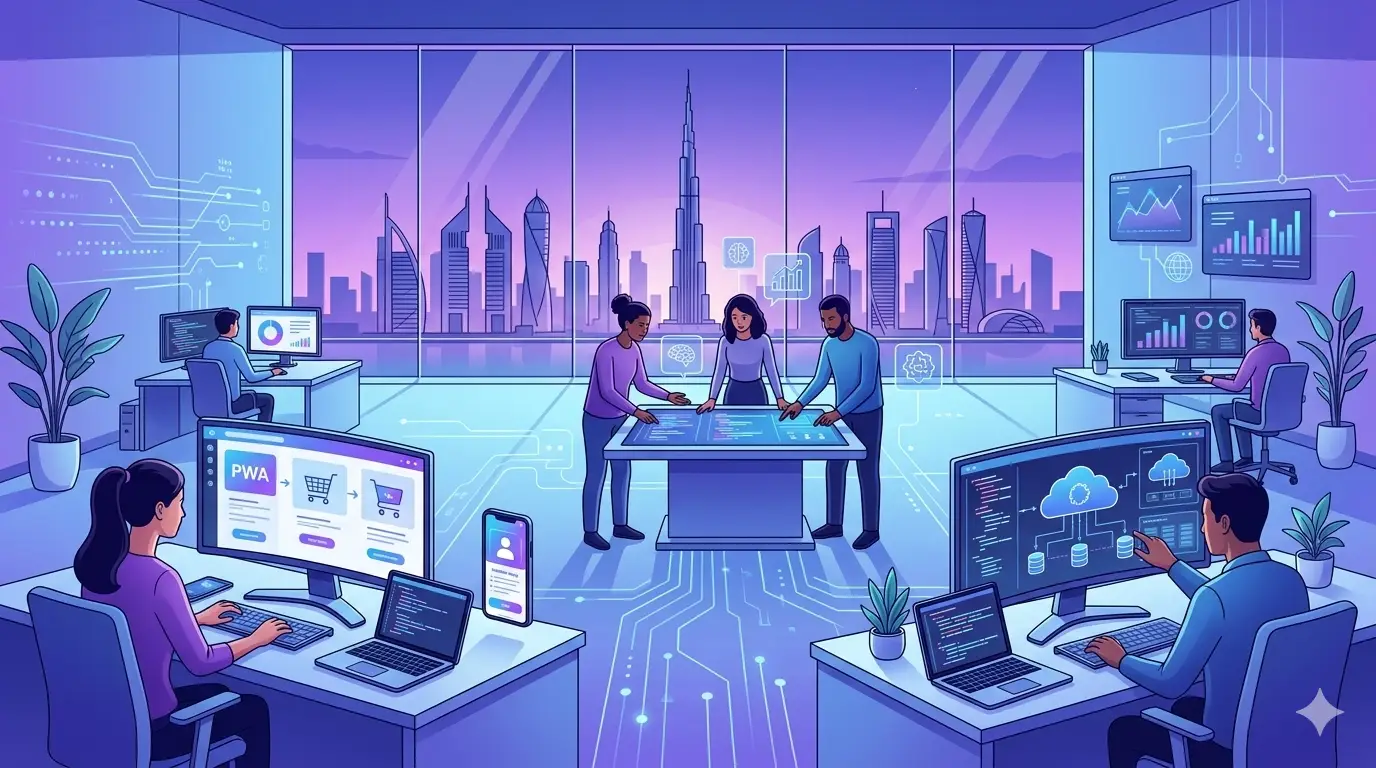

The web development landscape in the UAE is not standing still. As Dubai accelerates its D33 economic agenda and Abu Dhabi continues to invest heavily in technology infrastructure, the expectations UAE businesses place on their websites and digital platforms are rising sharply — and the technology used to meet those expectations is evolving just as fast.
For business owners in Dubai, Sharjah, and Abu Dhabi, keeping up with web development trends is not about chasing novelty. It is about understanding which shifts are redefining what customers expect from a digital experience — and making sure your business is not left behind by competitors who have already adapted.
This article breaks down the most significant web development trends shaping UAE businesses in 2026, explains why each one matters in the local market, and gives you practical steps to evaluate whether your current website is keeping pace.
Quick Answer: What Are the Top Web Development Trends in the UAE?
The leading web development trends for UAE businesses in 2026 include AI-powered personalisation, mobile-first and progressive web app development, headless and composable architecture, voice search optimisation for Arabic and English, Core Web Vitals performance as a ranking standard, enhanced cybersecurity practices, and the integration of real-time features such as live chat, dynamic pricing, and instant booking. Together these trends reflect a UAE digital market that is increasingly demanding faster, smarter, and more personalised online experiences.
Why Do UAE Businesses Need to Stay Current with Web Development Trends?
The UAE has one of the highest internet penetration rates in the world. Consumers and B2B buyers in Dubai and across the Emirates are digitally sophisticated — they compare options quickly, expect seamless mobile experiences, and will abandon a website that feels outdated within seconds of arriving.
At the same time, the UAE government’s own digital initiatives — from Smart Dubai to Abu Dhabi’s digital government transformation — are raising the baseline expectation for what a professional digital platform looks and performs like. When public services are setting a high standard, private sector businesses feel the pressure to match it.
Staying current with web development trends in the UAE is not about adopting every new technology. It is about understanding which shifts are becoming standard expectations rather than optional extras — and ensuring your digital presence meets those expectations before your competitors do.
Trend 1: AI-Powered Personalisation and Smart User Experiences
Artificial intelligence is moving from a background tool to a front-facing feature on UAE business websites. Businesses in Dubai are increasingly using AI to deliver personalised content, product recommendations, and user journeys based on browsing behaviour, location, and past interactions.
For e-commerce businesses in the UAE, AI-driven recommendations are already delivering measurable increases in average order value and repeat purchase rates. For service businesses, AI-powered chat assistants that can answer common questions in both Arabic and English are reducing response times and capturing leads around the clock.
The UAE’s National AI Strategy 2031 is actively encouraging AI adoption across sectors. Businesses that integrate AI-driven features into their web platforms now are building a capability that will be difficult for slower-moving competitors to replicate quickly.
Trend 2: Mobile-First Development and Progressive Web Apps
Mobile-first is no longer a trend in the UAE — it is the baseline. Over 90 percent of internet users in the Emirates browse on smartphones. What is evolving is how seriously development teams are applying mobile-first principles, and how Progressive Web Apps (PWAs) are changing the calculus for businesses weighing a native app against a mobile-optimised website.
A PWA delivers an app-like experience through the browser — it can work offline, send push notifications, load almost instantly, and be added to a user’s home screen without requiring an App Store download. For UAE retail, hospitality, and service businesses that want app functionality without the cost and maintenance burden of a native iOS and Android build, PWAs represent a genuinely compelling option in 2026.
Trend 3: Headless and Composable Architecture
Traditional websites couple the front-end (what users see) with the back-end (where content is managed) in a single system. Headless architecture separates the two, allowing businesses to deliver content across websites, mobile apps, in-store displays, and other channels from a single content source.
For growing businesses in Dubai and Abu Dhabi — particularly those expanding across the GCC or adding new customer touchpoints — headless architecture offers significant flexibility. Content updates happen once and publish everywhere. Design changes on one channel do not require rebuilding another.
This approach is gaining adoption among UAE enterprises in retail, real estate, and hospitality — sectors where consistent brand experience across multiple digital and physical touchpoints is a competitive priority.
Trend 4: Voice Search Optimisation for Arabic and English
Voice search is growing rapidly in the UAE, driven by smartphone assistant usage and the increasing adoption of smart home devices. What makes this trend particularly significant in the UAE context is the bilingual nature of the market — users search in both Arabic and English, and sometimes a combination of both.
Websites that are not optimised for voice search are missing an increasingly large segment of search traffic. Voice queries tend to be longer and more conversational than typed searches. Content structured around natural questions and direct answers — such as FAQ sections with concise, spoken-language responses — performs significantly better in voice search results.
Optimising for Arabic voice search is still an underutilised opportunity for most UAE businesses, making it a genuine differentiator for those who address it early.
Trend 5: Core Web Vitals as a Performance Standard
Google’s Core Web Vitals — which measure loading speed, visual stability, and responsiveness — are now established ranking signals. In the UAE, where mobile performance varies across network conditions and competition for search visibility is intense, these metrics have a direct and measurable effect on both traffic and conversion.
Businesses in Dubai and Sharjah that have not audited their Core Web Vitals performance in the past twelve months are likely leaving search rankings and leads on the table. The standard is rising as more agencies build performance into their development process from the start rather than treating it as a post-launch optimisation task.
Trend 6: Strengthened Cybersecurity and Data Privacy Features
The UAE’s Personal Data Protection Law (PDPL) establishes clear requirements for how businesses collect, process, and store user data online. As awareness of data rights grows among UAE consumers and enforcement of data regulations increases, businesses that have not addressed privacy and security on their websites face both reputational and legal risk.
From a web development perspective, this means implementing proper consent management, secure data handling practices, clearly structured privacy policies, and server-side infrastructure that meets UAE regulatory requirements. These are no longer optional considerations — they are features that professional web development in the UAE must address as standard.
Trend 7: Real-Time Features and Instant Engagement
UAE consumers expect immediacy. Businesses in Dubai are investing in real-time web features — live chat, instant quote calculators, dynamic availability displays, real-time inventory, and automated appointment booking — because they convert visitors who are ready to act right now rather than asking them to wait for a response.
WhatsApp integration remains one of the highest-impact real-time features for UAE business websites specifically, given the platform’s dominance across the Emirates. Businesses that allow visitors to initiate a WhatsApp conversation directly from any page of their website consistently report higher lead volumes than those relying on contact forms alone.
Key Takeaways
- The top web development trends for UAE businesses in 2026 include AI personalisation, mobile-first and PWA development, headless architecture, voice search optimisation, Core Web Vitals performance, enhanced cybersecurity, and real-time engagement features.
- UAE consumers are among the most digitally demanding in the world — trends that are “emerging” in other markets are often becoming baseline expectations here.
- Arabic and English bilingual support is a thread that runs through multiple trends, from voice search to AI chat to mobile experience.
- Core Web Vitals performance directly affects Google rankings — poor scores are actively costing businesses in Dubai search visibility and leads.
- UAE data protection regulations make privacy and security features a legal requirement, not just a best practice.
- Not every trend requires an immediate rebuild — prioritise by impact and work with a development partner who can help you sequence improvements intelligently.
Frequently Asked Questions
What are the biggest web development trends in the UAE in 2026?
The most significant web development trends for UAE businesses in 2026 are AI-powered personalisation, mobile-first and progressive web app development, headless and composable content architecture, voice search optimisation in Arabic and English, Core Web Vitals performance as a Google ranking factor, strengthened cybersecurity and UAE PDPL compliance, and real-time engagement features such as WhatsApp integration, live chat, and instant booking. These trends reflect rising customer expectations and the UAE’s position as one of the most digitally advanced markets in the world.
How do web development trends in the UAE differ from global trends?
UAE web development trends share the same broad directions as global trends but have a distinct local dimension. Bilingual Arabic and English support is a structural requirement rather than an optional extra. WhatsApp integration is a near-universal expectation because of the platform’s dominance in the GCC. The UAE’s National AI Strategy and government digital transformation initiatives accelerate enterprise adoption of AI and advanced architecture faster than many comparable markets. And data privacy requirements under the UAE PDPL create specific compliance obligations that shape how websites are built.
Should UAE businesses invest in Progressive Web Apps in 2026?
Yes, for many UAE businesses a Progressive Web App is a highly practical investment in 2026. PWAs deliver app-like experiences through the browser — including offline functionality, push notifications, and fast loading — without requiring a separate native app build for iOS and Android. For businesses in UAE retail, hospitality, service industries, or any sector where frequent mobile engagement matters, PWAs offer strong ROI relative to the cost of building and maintaining native apps on two separate platforms.
How does voice search affect web development for UAE businesses?
Voice search is growing in the UAE due to high smartphone penetration and smart device adoption. It requires web development teams to structure content around natural, conversational queries rather than short typed keywords — particularly in FAQ formats that directly answer common questions. For UAE businesses, Arabic voice search optimisation is an underutilised opportunity. Websites that structure Arabic content for voice queries are competing in a space where most competitors have not yet invested, making early adoption a genuine advantage.
How often should a UAE business update or rebuild its website?
Significant design or platform rebuilds are typically warranted every three to four years as technology standards and user expectations shift. However, performance improvements, feature additions, and content updates should be ongoing — monthly at minimum for content, and continuously for security patches and performance monitoring. The best approach is to work with a development agency in Dubai on a retainer basis, ensuring the site evolves incrementally rather than requiring periodic full rebuilds.
Conclusion
Web development trends in the UAE are not abstract technology news. They are a direct reflection of what UAE customers now expect from the businesses they interact with online — and increasingly, of what the UAE government expects from the digital infrastructure of its private sector.
The businesses in Dubai, Abu Dhabi, and Sharjah that treat their websites as evolving digital assets — not static brochures built once and forgotten — are the ones consistently outperforming competitors who are still operating on the standards of three years ago.
Keeping pace with these trends does not require rebuilding from scratch every year. It requires a development partner who understands the UAE market, stays current with the technology landscape, and helps you invest in the right improvements at the right time.
W3Torch is a UAE-based digital agency helping businesses across Dubai, Abu Dhabi, and Sharjah build and evolve websites, mobile apps, and software platforms that reflect where the market is heading — not where it has been. From performance optimisation and bilingual development to AI feature integration and progressive web apps, W3Torch works with UAE businesses that are serious about staying ahead.
Reach out to W3Torch to discuss how your website measures up against current UAE web development standards — and what your next move should be.