

If you have ever briefed a web development agency in Dubai and heard the words “frontend,” “backend,” and “full-stack” used interchangeably — or not explained at all — you are not alone. Most business owners in the UAE are not developers. They are building a business, not studying computer science, and yet they are regularly asked to make decisions that depend on understanding the difference between these two layers of any digital product.
The distinction between frontend and backend development matters for UAE businesses for a practical reason: the problems your website or application needs to solve determine which type of development requires the most investment. A business whose primary need is a visually compelling, fast-loading customer-facing website needs exceptional frontend work. A business whose primary need is complex data processing, integrations with multiple external systems, or a secure customer portal needs significant backend architecture. Most businesses need both — but rarely in equal measure, and understanding the difference helps you evaluate agency proposals, ask the right questions, and ensure the budget is allocated appropriately.
This guide explains frontend and backend development in plain terms, describes what each involves in the UAE context, and gives business owners in Dubai, Abu Dhabi, and Sharjah a clear framework for understanding what their specific project requires.
Quick Answer: What Is the Difference Between Frontend and Backend Development in the UAE?
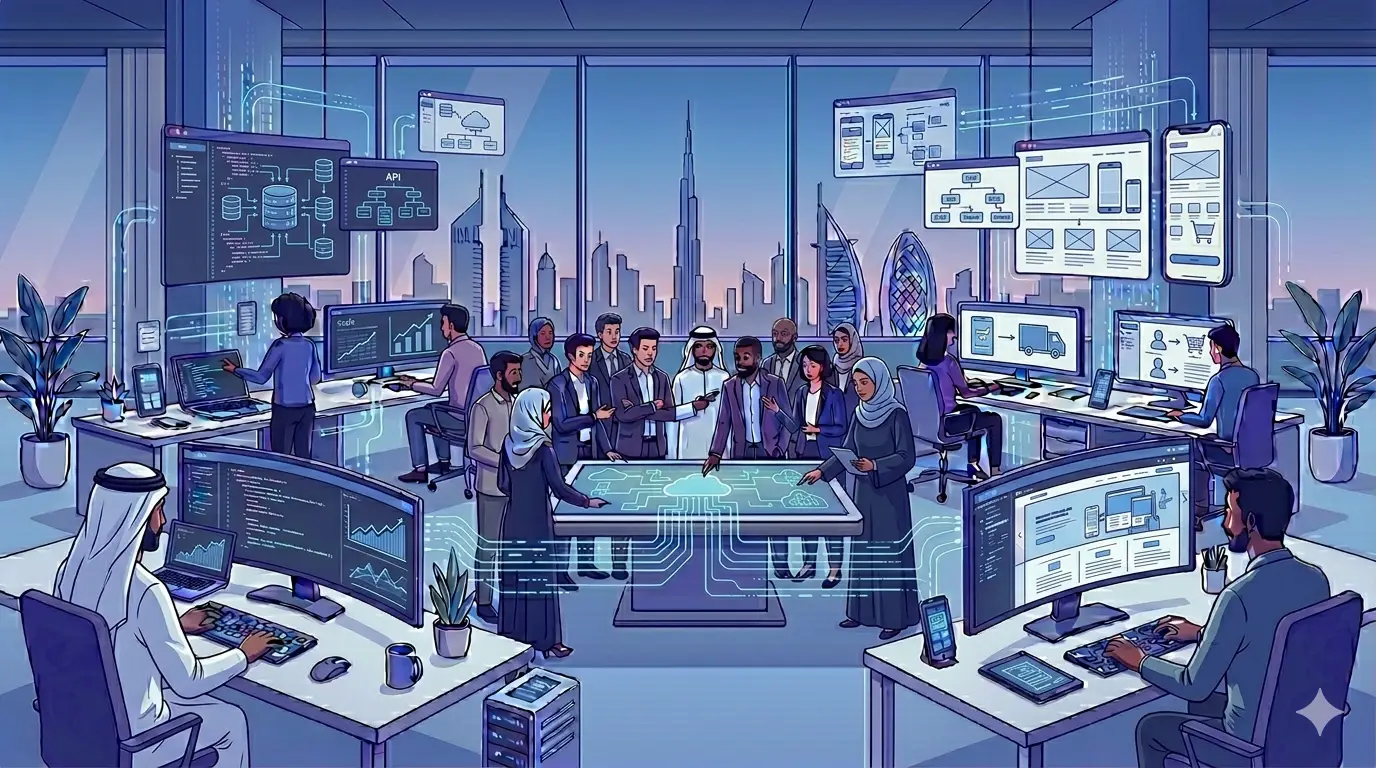
Frontend development is everything a user sees and interacts with on a website or application — the design, layout, animations, navigation, and the code that makes them work in the browser. Backend development is everything that happens behind the scenes — the servers, databases, business logic, APIs, and data processing that the user never sees but that make the website function. For UAE businesses, both are essential for a complete digital product, but the balance of investment between them depends on the nature of the project: design-heavy marketing websites require more frontend expertise, while data-driven applications, customer portals, and integrations require significant backend development.
What Is Frontend Development?
Frontend development is the practice of building everything that appears in a user’s browser or on their screen. A frontend developer takes the visual designs produced by a UI/UX designer and turns them into functional, interactive web pages using code.
The core technologies of frontend development are:
HTML (HyperText Markup Language) — the structure of a web page, defining what elements are present and in what order: headings, paragraphs, images, forms, and links.
CSS (Cascading Style Sheets) — the presentation layer, defining how those elements look: colours, fonts, spacing, layout, and responsive behaviour across different screen sizes.
JavaScript — the behaviour layer, adding interactivity to the page: animations, form validation, content that updates without a full page reload, and the dynamic interactions that make modern websites feel responsive and alive.
Modern frontend development typically uses JavaScript frameworks — React, Next.js, or Vue.js — that structure complex interfaces into reusable components and improve both development efficiency and application performance.
For UAE businesses, frontend development is where Arabic right-to-left layout is implemented. Correct RTL requires changes not just to text direction but to layout flow, navigation placement, icon orientation, and the visual hierarchy of every page — making experienced bilingual frontend development a specific and valuable expertise in the UAE market.
What Is Backend Development?
Backend development is everything that happens on the server — the code, databases, and infrastructure that process requests from the frontend, retrieve or store data, enforce business rules, and return the appropriate response.
When a user in Dubai submits a contact form, the frontend sends that data to the backend. The backend validates it, stores it in a database, sends a confirmation email, and returns a success message to the frontend. The user never sees any of this — they only see the confirmation message — but without the backend, none of it happens.
Backend development encompasses:
Server-side languages and frameworks — Node.js, Laravel (PHP), Python (Django or FastAPI), or Ruby on Rails — which handle the logic of the application: processing requests, enforcing rules, and communicating with databases and external services.
Databases — where the application’s data lives: user accounts, orders, content, transactions, and any other information the application needs to store and retrieve.
APIs (Application Programming Interfaces) — the structured communication channels that allow the frontend to request data from the backend, and that allow different software systems to communicate with each other.
Authentication and security — the backend is responsible for ensuring that users are who they say they are, that data is accessible only to authorised users, and that the application is protected against common security vulnerabilities.
For UAE businesses, backend development is where UAE payment gateway integrations (Network International, PayTabs, Telr) are built, where compliance with the UAE PDPL’s data handling requirements is implemented, and where the business logic that makes a platform commercially functional is encoded.
What Is Full-Stack Development and When Is It Relevant for UAE Businesses?
A full-stack developer works across both the frontend and backend — capable of building a complete web application from the user interface to the database, without requiring separate specialists for each layer.
Full-stack development is commercially attractive for UAE businesses because it appears to reduce the number of developers required and simplifies communication. One developer who can handle everything is simpler to manage than two specialists working in coordination.
The trade-off is depth. A full-stack developer who covers everything typically covers each layer less deeply than a specialist. For simple to mid-range UAE business websites — a corporate site, a blog, a moderate e-commerce store — full-stack development is entirely appropriate and cost-efficient. For complex applications with sophisticated user interfaces and complex backend logic simultaneously, specialist frontend and backend developers working in coordination typically produce better results.
Most professional web development agencies in Dubai use both models depending on the project type: full-stack developers for contained projects, and specialist frontend and backend teams for complex platforms.
What Does UAE Business Type Determine About Frontend vs Backend Needs?
Corporate and informational websites in Dubai These are primarily frontend projects. The design quality, page speed, mobile experience, and bilingual Arabic and English implementation are the commercial priorities. The backend is typically a CMS — WordPress, Webflow, or a headless CMS — that requires configuration rather than extensive custom development.
E-commerce websites in the UAE Both layers are significant. The frontend determines the browsing and checkout experience — conversion-critical on mobile for UAE shoppers. The backend handles product management, inventory, order processing, payment gateway integration, and customer account management. The balance between frontend and backend investment is relatively even.
Custom web applications and customer portals Backend-dominant projects. The user interface may be clean but not visually complex — the commercial value is in the business logic: multi-role access control, data workflows, reporting, integration with external UAE systems (CRM, ERP, logistics platforms). A significant proportion of the development budget goes to backend architecture.
SaaS products for the UAE market Roughly equal investment in both layers, but the backend — particularly multi-tenancy architecture, subscription billing, and API design — is where the product’s scalability and commercial model is built.
Marketing and campaign landing pages Almost entirely frontend. Performance, visual quality, and conversion optimisation are the priorities. Backend involvement is limited to form handling and any tracking pixel or analytics integration
What Does Frontend and Backend Development Cost in Dubai?
Development costs in Dubai reflect the seniority, specialisation, and team size required for the project.
Freelance rates in Dubai:
- Junior frontend developer: AED 60 – AED 120 per hour
- Senior frontend developer (React/Next.js specialist): AED 150 – AED 300 per hour
- Backend developer (Node.js/Laravel): AED 100 – AED 250 per hour
- Full-stack developer: AED 80 – AED 200 per hour
Agency project rates (all-inclusive):
- Frontend-heavy corporate website (custom design, bilingual): AED 18,000 – AED 45,000
- Full-stack e-commerce platform: AED 25,000 – AED 80,000
- Backend-heavy custom web application: AED 50,000 – AED 200,000+
- Complex SaaS platform (both layers at scale): AED 150,000 – AED 500,000+
These ranges reflect the Dubai market in 2026 and assume professional development — not template-based shortcuts that appear in lower-cost proposals.
Practical Steps: How UAE Businesses Can Understand Their Development Needs
Step 1: Describe your website or application in terms of what it must do, not what it must look like List the actions users must be able to take on your platform: browse, search, filter, book, pay, upload, download, view their account, communicate with your team. Actions that involve storing, retrieving, or processing data require backend development. Actions that involve only visual presentation require frontend. The ratio of these action types in your list reveals the frontend vs backend balance your project requires.
Step 2: Identify every external system the project must connect to List every third-party service, platform, or system your website must integrate with: UAE payment gateways, CRM, ERP, logistics tracking, government portals, analytics tools, marketing automation. Each integration is a backend development task. The more integrations required, the more significant the backend investment in your project.
Step 3: Ask your development agency specifically which team members will work on your project When evaluating agencies in Dubai, ask who will work on your project — a full-stack developer, a frontend and backend team, or a combination. Understand the seniority level of the developers assigned to your work. An agency proposal that prices a complex application as if it requires one junior full-stack developer is either mispricing the project or planning to deliver below the required standard.
Step 4: Evaluate frontend quality through live mobile testing of portfolio sites For frontend-dominant projects, the only meaningful evaluation of an agency’s frontend capability is testing their live portfolio work on a real mobile device. Open the site on a mid-range Android smartphone. Navigate through it. Test the Arabic version if they have one. Run it through Google PageSpeed Insights. Frontend quality shows immediately in these tests — it cannot be hidden in a PDF portfolio.
Step 5: Evaluate backend quality through technical conversation, not visual demonstration Backend quality is not visible — it lives in the code, the database design, and the architecture. Evaluate backend capability by asking the agency specific technical questions: how do they handle authentication and session management? How do they prevent SQL injection? What is their approach to database schema design for a multi-role application? How do they manage API versioning? Confident, specific answers indicate genuine backend expertise.
Step 6: Require documentation of the backend architecture before development begins For any project with significant backend complexity, require the agency to produce a technical architecture document — covering the API structure, database schema, third-party integration approach, security model, and deployment infrastructure — before development begins. This documentation makes the backend work reviewable by a third party, reduces the risk of architectural errors discovered late, and gives you a recoverable asset if the agency relationship ends before the project completes.
Key Takeaways
- Frontend development is everything users see and interact with — design, layout, animations, and interactive behaviour. Backend development is everything behind the scenes — servers, databases, business logic, and integrations.
- For UAE businesses, the correct balance of frontend vs backend investment depends on the project type: marketing sites are frontend-dominant; custom applications and portals are backend-dominant; e-commerce and SaaS require significant investment in both.
- Arabic RTL implementation is a frontend development responsibility — it requires specific expertise that should be verified with live UAE portfolio evidence.
- UAE payment gateway integrations, data compliance under the UAE PDPL, and business logic are backend responsibilities — verify backend capability through technical conversation, not visual portfolio review.
- Full-stack developers are appropriate for contained projects; specialist frontend and backend developers produce better results for complex platforms.
- Always require a technical architecture document for backend-significant projects before development begins.
Frequently Asked Questions
What is the difference between frontend and backend development for UAE businesses?
Frontend development is everything a user sees and interacts with on a website or application — the layout, design, navigation, animations, and visual behaviour in the browser. Backend development is everything that happens on the server — the databases, business logic, APIs, integrations, and data processing that make the website function. For UAE businesses, frontend quality determines how the website looks and performs for visitors, while backend quality determines how reliably the website processes data, integrates with external services, and handles business logic securely.
Do UAE businesses need both frontend and backend development?
Most UAE business websites need both, but in different proportions depending on the project. A corporate informational website is primarily a frontend project — the CMS is configured rather than custom-built, and the commercial value is in design quality and performance. A custom web application, customer portal, or SaaS product requires significant investment in both layers. An e-commerce platform requires equally substantial frontend (the shopping and checkout experience) and backend (product management, payment processing, order management) development.
What is a full-stack developer and is one enough for a UAE business website?
A full-stack developer works across both frontend and backend layers — capable of building a complete web application independently. For simple to mid-range UAE business websites, one or two full-stack developers are often sufficient and cost-efficient. For complex platforms requiring sophisticated user interfaces and intricate backend logic simultaneously — enterprise applications, SaaS products, marketplaces — specialist frontend and backend developers working in coordination typically produce better results than a single full-stack generalist covering both layers less deeply.
How do I evaluate frontend quality when choosing a web developer in Dubai?
Evaluate frontend quality by testing live portfolio work on a mid-range Android smartphone. Navigate through the site as a first-time visitor. Check load speed using Google PageSpeed Insights. Test the Arabic version independently if bilingual development is in their portfolio — look for genuine RTL layout, correct navigation mirroring, and consistent Arabic typography across all page types. Frontend quality is immediately apparent in live testing in ways that portfolio screenshots cannot reveal.
How do I evaluate backend quality when choosing a web developer in Dubai?
Backend quality is not visible to the eye — it lives in code, database design, and architecture. Evaluate it through technical conversation: ask how the agency approaches authentication and session security, SQL injection prevention, API design, and UAE payment gateway integration. Ask for examples of backend documentation from previous projects. Request that any complex backend project begin with a documented technical architecture that covers database schema, API structure, and security model. An agency that cannot discuss its backend approach confidently or refuses to document it before development begins is not a safe partner for a backend-significant project.
Conclusion
Understanding the difference between frontend and backend development does not require technical expertise — it requires the ability to describe what your website or application must do and connect those requirements to the appropriate development discipline.
For UAE business owners in Dubai, Abu Dhabi, and Sharjah, this understanding has a direct commercial value: it helps you evaluate proposals accurately, allocate budget appropriately, and ask the questions that reveal whether an agency has the specific capabilities your project actually requires — rather than the general capabilities their portfolio presentation implies.
W3Torch is a UAE-based digital agency with specialist frontend developers experienced in bilingual Arabic and English RTL implementation and senior backend engineers capable of complex application architecture, UAE payment integration, and data-compliant system design. Whether your project is a visually demanding marketing website, a data-driven customer portal, or a full-platform SaaS product, W3Torch matches the right technical expertise to your specific requirements.
Get in touch with W3Torch to discuss your project and find out what the right development team looks like for what you are building.