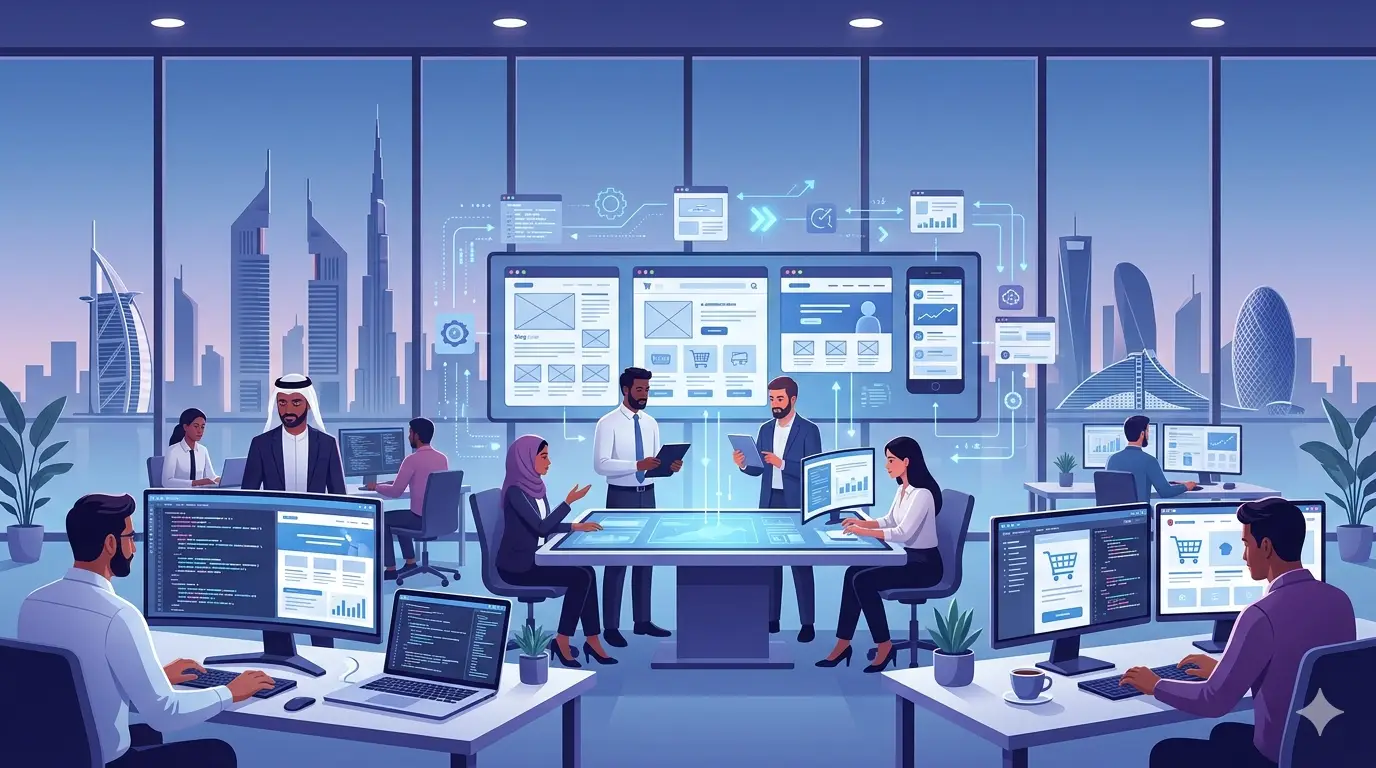

Every business website needs a way to manage its content — adding new service pages, publishing blog posts, updating team profiles, and keeping product information current. The system that makes this possible is the CMS: the content management system.
Choosing the right CMS platform for your UAE business website is a decision that will shape your day-to-day digital operations for years. The wrong choice means a website that is frustrating to update, slow to load, difficult to optimise for search, and increasingly unable to meet your business’s growing needs. The right choice means a platform that makes your team more efficient, your content more current, and your website more competitive.
For businesses in Dubai, Abu Dhabi, and Sharjah, the CMS decision has an additional dimension: the need for a platform that handles Arabic content and right-to-left layout properly, integrates with UAE-specific business tools, and performs well for a mobile-dominant audience. Not all CMS platforms meet these requirements equally well.
This guide compares the most widely used CMS platforms for UAE business websites in 2026, explains which scenarios each is best suited to, and gives you a clear framework for making the right choice for your business.
Quick Answer: What Are the Best CMS Platforms for UAE Business Websites?
The best CMS platforms for UAE business websites in 2026 are WordPress for content-driven sites and SME businesses on moderate budgets, Webflow for design-forward marketing sites that need visual flexibility without custom development, Sanity and Contentful for headless architectures requiring strong bilingual Arabic and English content management, and custom-built CMS solutions for businesses with complex workflows that no off-the-shelf platform addresses cleanly. Shopify remains the leading CMS for standard e-commerce. The right platform depends on your content management needs, technical resources, budget, Arabic language requirements, and growth trajectory.
What Is a CMS and Why Does It Matter for UAE Businesses?
A content management system (CMS) is the software layer that allows non-technical users to create, edit, and publish website content without writing code. It separates the content — text, images, videos, documents — from the design and code that present it to visitors.
Without a CMS, every update to a website requires a developer. With a well-chosen CMS, a marketing manager in a Dubai business can publish a new blog post, update a product price, or add a team member’s profile in minutes without any technical involvement.
For UAE businesses, the CMS choice also has direct implications for SEO performance, website speed, bilingual content management, and the ability to integrate with CRM, analytics, and marketing automation tools. Choosing a CMS that is underpowered for your needs, or overpowered without the technical team to manage it, creates operational friction that compounds over time.
WordPress: The Default Choice for Most UAE Business Websites
WordPress powers a significant share of websites globally and remains the most widely used CMS for business websites in the UAE. Its market dominance reflects genuine strengths — but also comes with well-understood limitations that UAE businesses should evaluate honestly.
What WordPress does well WordPress is highly flexible and supports an enormous ecosystem of themes and plugins that extend its functionality. For a business that needs a professional informational website, a blog, or a moderately featured e-commerce store, WordPress typically delivers everything required at a cost — both in development and ongoing management — that is manageable for SMEs in Dubai and Sharjah.
For bilingual websites, WordPress supports Arabic and RTL layout through dedicated multilingual plugins such as WPML and Polylang, and RTL-compatible themes are widely available. The quality of Arabic implementation varies based on theme selection and developer skill — but strong bilingual WordPress sites are entirely achievable.
Where WordPress creates challenges WordPress accumulates technical debt. Plugins conflict, themes require constant updates, and performance degrades without active maintenance. Security vulnerabilities are frequent because the platform’s ubiquity makes it a persistent target. And as business requirements grow more complex — custom workflows, API integrations, multi-role user management — WordPress bends rather than breaks, but the workarounds required often produce inconsistent results.
Best suited for: SME businesses in UAE needing a professional website, blog, or simple e-commerce store; businesses with a clear budget ceiling; teams that need an interface their non-technical staff can manage independently.
Webflow: Design Freedom Without Heavy Development Dependency
Webflow is a visual web design and CMS platform that gives designers significantly more creative control than WordPress themes allow, without requiring full custom development. It is growing in adoption among UAE marketing teams and design-focused businesses.
What Webflow does well Webflow produces clean, performant code from visual design — which means websites built on it typically have better Core Web Vitals scores than comparable WordPress builds. It handles hosting, security, and CDN through its own infrastructure, reducing the operational overhead of platform management. Its CMS interface is clean and well-structured for marketing teams.
Where Webflow creates challenges Webflow’s Arabic and RTL support has improved but is not yet at the level that WordPress with a dedicated RTL theme delivers out of the box. Complex custom functionality — user accounts, payment processing beyond standard setups, dynamic data from external databases — requires workarounds or integrations that add complexity. Webflow’s CMS is also less flexible for businesses with deeply structured content types.
Best suited for: Marketing-led UAE businesses that prioritise design quality and team content independence; professional services, agency, and creative sector websites in Dubai where visual differentiation is a priority.
Sanity: The Leading Headless CMS for Bilingual UAE Platforms
Sanity is a headless CMS — meaning it manages and stores content separately from how that content is presented, delivering it to any front-end through an API. For UAE businesses with bilingual content requirements, high performance targets, or a need to publish the same content across a website, a mobile app, and other channels simultaneously, Sanity is one of the most capable platforms available.
What Sanity does well Sanity’s content model is fully customisable — content types, fields, validation rules, and editorial workflows are all defined by the development team to match the business’s exact requirements. Its Arabic language support is clean because content is stored and delivered independently of any layout — RTL presentation is handled by the front-end, not fought over with a theme. Performance is excellent because the front-end (typically built in Next.js or React) is optimised independently of the CMS.
Where Sanity creates challenges Sanity requires a professional development team to implement and configure. It is not a platform that a non-technical user can deploy independently. The investment in a headless architecture — both in initial development cost and the technical knowledge required to manage it — is higher than a WordPress or Webflow build.
Best suited for: UAE businesses with complex content models, strong bilingual requirements, or a need to deliver content across multiple platforms; enterprises and growth-stage businesses in Dubai or Abu Dhabi with in-house or agency-based technical support.
Contentful: Enterprise-Grade Headless CMS for Large UAE Organisations
Contentful is the enterprise-tier alternative to Sanity in the headless CMS space. It is used by large organisations that need structured content management at scale — multiple editors, complex editorial workflows, content governance, and delivery to multiple digital channels.
What Contentful does well Contentful’s editorial interface is polished and accessible for large non-technical teams. Its role-based permissions, content modelling tools, and multi-environment support make it appropriate for organisations with significant content operations — multiple UAE locations, regional language variants, or high-volume publishing workflows.
Where Contentful creates challenges Contentful’s pricing is enterprise-level. For SMEs in the UAE, the cost-to-value ratio is not competitive with alternatives. Like Sanity, it requires a professional development team to implement.
Best suited for: Large corporations, regional enterprises, and government-adjacent organisations in the UAE managing high-volume, multi-language content across multiple digital channels.
Custom CMS: When No Off-the-Shelf Platform Fits
For UAE businesses with workflows that no standard platform addresses — complex product configurators, multi-role editorial processes, deep integration with proprietary business systems, or highly specific content models — a custom-built CMS is sometimes the most practical solution.
A custom CMS is built alongside the website or application itself, designed to match exactly how the business’s content team works. It is the most expensive option upfront but eliminates the compromises and workarounds that businesses with complex requirements inevitably accumulate on generic platforms.
Best suited for: Enterprises or complex businesses in Dubai with content workflows that consistently exceed what standard CMS platforms can accommodate cleanly.
How to Choose the Right CMS Platform for Your UAE Business: Practical Steps
- Step 1: Document how your team will actually use the CMS Who will be adding and editing content? How often? What types of content — pages, blog posts, products, events, team profiles, case studies? How many people need access, and with what levels of permission? The answers to these questions determine what CMS features actually matter for your business.
- Step 2: Assess your Arabic language requirements If your website requires a genuine bilingual Arabic and English experience, evaluate each platform specifically on the quality of its Arabic RTL support — not just whether it technically supports Arabic. Ask your agency to show you live UAE bilingual sites built on each platform you are considering.
- Step 3: Be honest about your team’s technical capability A headless CMS like Sanity or Contentful is significantly more powerful than WordPress — but it also requires a technically capable team or agency to implement and maintain. Match your CMS choice to your actual available technical resources, not the aspirational capabilities you plan to have in the future.
- Step 4: Consider your three-year content growth plan A CMS that works for fifty pages today may create real problems at five hundred pages, in three languages, across multiple product categories. If your content operation is expected to grow significantly, choose a platform built to scale with that growth rather than one that requires migration when you reach its ceiling.
- Step 5: Ask your development agency which CMS they recommend for your specific project and why A credible agency will recommend a CMS based on your requirements — not their preferred platform or the one they are most comfortable with. If an agency recommends the same platform for every client regardless of scope, that is a signal they are not thinking carefully about your specific needs.
Key Takeaways
- The best CMS for a UAE business website depends on content complexity, bilingual requirements, team technical capability, budget, and growth trajectory — not on which platform is most popular globally.
- WordPress is the right choice for most SME businesses in the UAE needing a professional website at a manageable cost — provided Arabic RTL is implemented properly and ongoing maintenance is taken seriously.
- Webflow offers better performance and design flexibility than WordPress for marketing-led UAE businesses that do not need complex custom functionality.
- Sanity and Contentful are the leading headless CMS platforms for UAE businesses with strong bilingual requirements, complex content models, or multi-channel delivery needs.
- Custom CMS solutions are the right choice when business workflows consistently exceed what any standard platform can accommodate cleanly.
- Always evaluate Arabic language support on live UAE projects — not on a platform’s marketing claims.
Frequently Asked Questions
What is a CMS platform and why do UAE businesses need one?
A content management system (CMS) is software that allows non-technical users to create, edit, and publish website content without writing code. UAE businesses need a CMS because their websites require ongoing content updates — new pages, blog posts, product information, event announcements, and team profiles — and depending on a developer for every change is both slow and expensive. The right CMS gives the business’s own team the tools to keep the website current and accurate without technical involvement.
Which CMS is best for Arabic language websites in the UAE?
For Arabic language support, headless CMS platforms like Sanity and Contentful offer the cleanest implementation because content is stored language-neutrally and RTL presentation is handled entirely by the front-end. WordPress with a properly configured RTL-compatible theme and a multilingual plugin such as WPML also produces strong bilingual results when implemented carefully. Webflow’s Arabic support is improving but requires more careful configuration. The quality of any platform’s Arabic experience ultimately depends as much on the developer’s skill as on the platform’s native capabilities.
What is a headless CMS and is it right for UAE businesses?
A headless CMS stores and manages content separately from how it is displayed, delivering content to any front-end via an API. This allows the same content to be published to a website, a mobile app, a digital display, or any other channel from a single source. It is right for UAE businesses that need to deliver content across multiple platforms, require high performance, or have complex bilingual content structures that standard CMS platforms handle poorly. It requires a professional development team to implement and is not appropriate for businesses without technical support.
How much does it cost to build a WordPress website in Dubai?
A professional WordPress website in Dubai typically costs between AED 8,000 and AED 30,000 depending on the complexity of the design, the number of pages, the features required, and whether bilingual Arabic and English support is included. This is a development cost for the initial build. Ongoing costs — hosting, security maintenance, plugin updates, and content support — add AED 500 to AED 3,000 per month depending on the level of support required.
Can I switch CMS platforms after my website is already live?
Yes, but it is not straightforward. Migrating content from one CMS to another — particularly between structurally different platforms like WordPress and a headless CMS — requires rebuilding the site in the new platform’s architecture and migrating content carefully to avoid data loss or structural errors. For most UAE businesses, the decision to change CMS platform is effectively a decision to rebuild the website. This is why choosing the right platform for your current and future needs at the start of the project is significantly more cost-effective than migrating later.
Conclusion
The CMS platform your UAE business website runs on is not a background technical decision — it is an operational one. It determines how quickly your team can publish new content, how well your website performs for visitors and in search, and how effectively it can scale as your business grows.
Getting this decision right requires honest answers to questions about how your team will actually use the CMS, what your bilingual requirements genuinely demand, and where your business will be in three years — not just three months.
W3Torch is a UAE-based digital agency with experience building and deploying websites on WordPress, Webflow, Sanity, Contentful, and fully custom CMS platforms for businesses in Dubai, Abu Dhabi, and Sharjah. We recommend platforms based on what your project actually needs — and we build bilingual Arabic and English CMS implementations that work correctly from day one.
Get in touch with W3Torch to discuss your website project and get an honest recommendation on the CMS platform that is right for your business.