
Most businesses in the UAE have built their website on a traditional CMS — WordPress, for example — where the content management system and the website’s front-end are tightly linked. When you update a page in the backend, it changes the website. Simple, familiar, and functional for millions of businesses worldwide.
But as UAE businesses grow more sophisticated in their digital operations — managing content across a website, a mobile app, a digital display in a hotel lobby, and a regional Arabic portal simultaneously — the traditional CMS model starts to show its limits. Updating the same content in four separate places is slow, error-prone, and increasingly untenable as the number of channels grows.
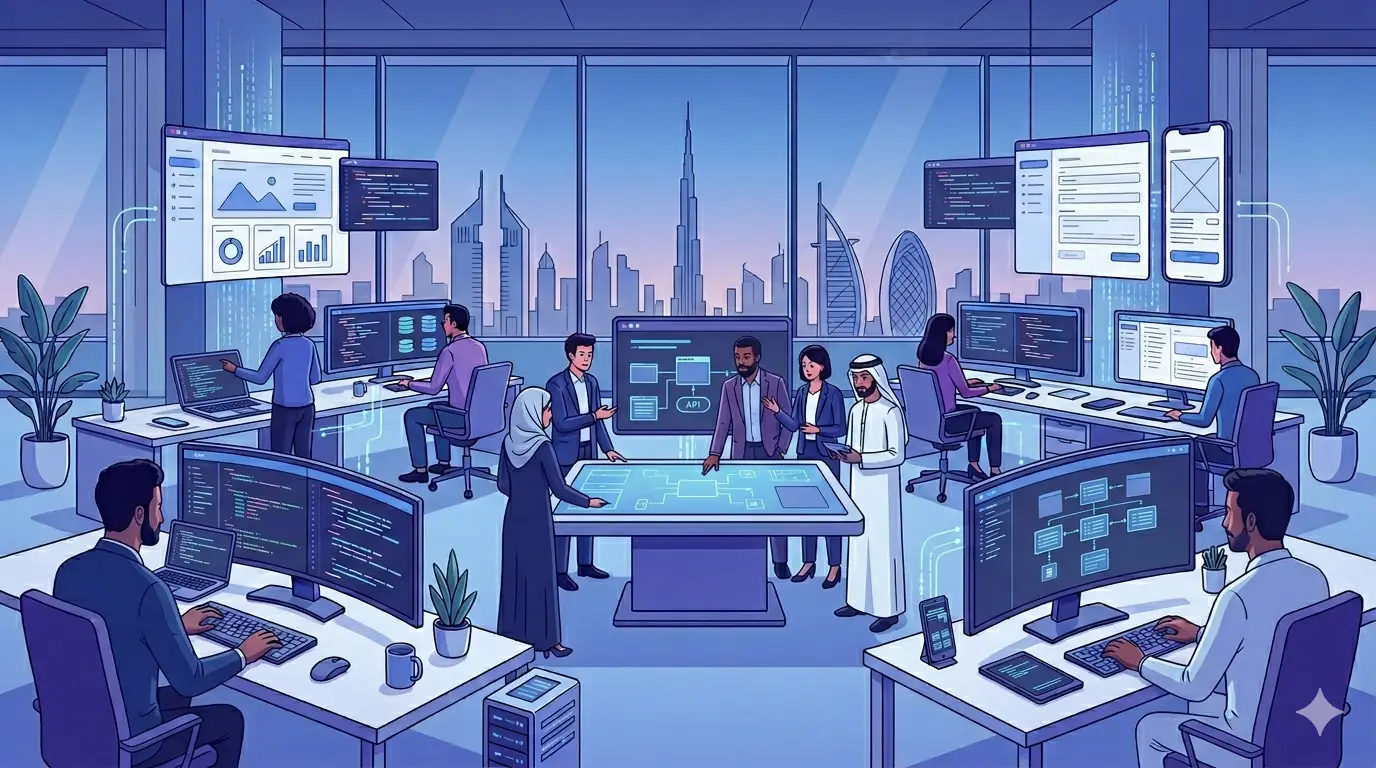
This is the business problem that headless CMS Development solves. By separating the content management layer from the presentation layer, a headless CMS allows UAE businesses to create content once and deliver it everywhere — consistently, efficiently, and with the speed and performance that modern audiences expect on every device.
For growing businesses in Dubai, Abu Dhabi, and Sharjah operating across multiple digital channels or planning to, understanding headless CMS is not just a technical education — it is a strategic one.
Quick Answer: What Is Headless CMS Development in the UAE?
Headless CMS Development in the UAE refers to building a website or digital platform where the content management system (the “body”) is decoupled from the front-end presentation layer (the “head”). Content is stored and managed in the CMS and delivered to any channel — website, mobile app, digital display, smartwatch, or regional portal — through an API. For UAE businesses managing bilingual Arabic and English content across multiple platforms, a headless CMS offers superior content flexibility, better performance, stronger bilingual architecture, and the ability to scale across new channels without rebuilding the content infrastructure.
What Is a Headless CMS?
A traditional CMS — like WordPress or Joomla — is a monolithic system. The content database, the editorial interface, and the front-end theme that presents content to visitors are all part of the same application. When a developer customises the front-end, they work within the constraints of the CMS’s templating system. When the content changes, it changes on the website directly.
A headless CMS removes the front-end entirely from the CMS’s responsibility. Content is stored in a structured, platform-agnostic way and exposed through an API — typically a REST or GraphQL API — that any front-end can query. The website, the mobile app, and the in-store digital display all request the same content from the same source and render it according to their own front-end logic.
The term “headless” refers to the removal of the “head” — the presentation layer — leaving only the content management body. The front-end is built separately, usually using a modern JavaScript framework like Next.js or React, and connects to the CMS via API to retrieve and display content.
The most widely used headless CMS platforms in UAE web development projects are Sanity, Contentful, Strapi, and Directus — each with different strengths in terms of content modelling, team collaboration features, pricing, and technical flexibility.
Why Is Headless CMS Development Valuable for UAE Businesses?
Multi-Channel Content Delivery Without Duplication
A UAE hospitality business might need to publish a new offer to its main English website, its Arabic portal, its mobile app, and its in-lobby kiosk display simultaneously. With a traditional CMS, this requires four separate content updates — or four separate websites with their own management overhead.
With a headless CMS, the offer is created once in the content management interface and delivered to all four channels through the same API. Each channel renders it according to its own layout and design. The content team manages one source of truth. The result is faster publishing, fewer errors, and consistent messaging across all touchpoints.
Superior Bilingual Architecture for Arabic and English
This is the headless CMS advantage that matters most for UAE businesses specifically. In a traditional CMS like WordPress, Arabic RTL support is applied through theme settings, plugins, and configuration — often imperfectly, and always within the constraints of a system that was designed for left-to-right reading by default.
In a headless architecture, the CMS stores Arabic and English content as structured data — two versions of the same content field, language-agnostic at the storage level. The front-end is built entirely separately and can implement Arabic RTL layout natively and precisely, with no theme limitations and no plugin conflicts. The result is a bilingual experience that is architecturally sound rather than technically workaround.
Front-End Performance at the Highest Level
Because the front-end is built independently — typically in Next.js with static site generation or server-side rendering — headless websites consistently achieve better Core Web Vitals scores than comparable traditional CMS builds. There is no theme framework adding unnecessary CSS, no plugin JavaScript loading on every page, and no server-side rendering bottleneck from a monolithic CMS.
For UAE businesses competing for Google search rankings in competitive markets like Dubai real estate, hospitality, or professional services, the performance advantage of a headless architecture is a genuine ranking differentiator.
Future-Proofing for New Digital Channels
The content infrastructure of a headless CMS does not need to be rebuilt when a new channel is added. When a Dubai retail business decides to launch a mobile app after operating only a website, the headless CMS already contains all the structured content — it simply needs a new front-end built to consume and display it. When a new voice search device or smart display becomes relevant to a UAE hospitality brand, the content API is already in place.
This future-flexibility is particularly valuable in the UAE, where the speed of digital adoption means new channels emerge and become commercially relevant faster than in many other markets.
What Are the Trade-Offs of Headless CMS Development in the UAE?
Headless CMS development is not the right choice for every UAE business. A balanced view requires acknowledging its limitations.
- Higher implementation cost and complexity A headless architecture requires more development expertise than a traditional CMS. The front-end must be built entirely separately, which takes more time and skill than installing a WordPress theme. For a small UAE business that needs a simple informational website updated weekly by a non-technical team member, the additional cost of a headless architecture is rarely justified by the return.
- Requires ongoing technical management Unlike WordPress, where a non-technical user can manage hosting, themes, and even some development tasks, a headless CMS environment requires technical oversight. API configurations, front-end deployments, and CMS environment management all need a developer or a retainer agency with headless experience.
- Editorial experience varies by platform The editorial interface quality varies significantly between headless CMS platforms. Contentful and Sanity both offer polished, user-friendly editorial interfaces. Other platforms require more configuration to produce an experience that non-technical content editors find accessible. For UAE businesses with large, non-technical content teams, platform selection should include evaluating the editorial experience carefully
What Does Headless CMS Development Cost in the UAE?
Headless CMS development cost in Dubai varies based on the platform chosen, the complexity of the content model, the number of channels being served, and whether bilingual Arabic and English support is required.
- Basic headless CMS setup with Next.js front-end (single channel): AED 25,000 – AED 55,000
- Professional headless website with bilingual Arabic and English and CMS editorial configuration: AED 50,000 – AED 100,000
- Multi-channel headless platform (website plus mobile app plus additional channels): AED 90,000 – AED 200,000+
- Enterprise headless CMS implementation with custom content modelling and team training: AED 150,000 – AED 400,000+
Ongoing platform costs depend on the CMS chosen — Contentful and Sanity both have subscription tiers ranging from free developer plans to enterprise contracts. Hosting for the Next.js or React front-end is typically on Vercel or a cloud provider with UAE-region availability, costing AED 200 – AED 2,000 per month depending on traffic volume
How to Approach Headless CMS Development in the UAE: Practical Steps
- Step 1: Assess whether your content operation genuinely requires it Before committing to a headless architecture, map your content channels honestly. If you currently manage a single website with monthly content updates managed by one person, a headless CMS adds cost and complexity without proportional return. If you manage content across a website, mobile app, Arabic and English portals, and regional channels — or plan to within two years — a headless architecture pays for itself in operational efficiency.
- Step 2: Choose your CMS platform based on editorial experience, not just technical capability Evaluate the editorial interface of every headless CMS platform you consider from the perspective of the content team members who will use it daily — not the developers who will configure it. Request a demo environment from each platform shortlisted. Have non-technical team members attempt to create and publish content without guidance. Platform selection based on developer preference alone often produces a system that the editorial team finds unusable.
- Step 3: Define your content model before any development begins The content model — the structured definition of every content type, its fields, its relationships, and its validation rules — is the most important design decision in a headless CMS project. A poorly structured content model creates constraints that become progressively more painful as the platform grows. Invest time in content modelling workshops before development begins.
- Step 4: Plan Arabic and English content fields as first-class requirements In your content model, every field that requires bilingual content should be designed from the start with separate Arabic and English field entries — not a single field with a language toggle. Define which fields are required in both languages and which are language-specific. This structural decision affects how content is stored, validated, and retrieved — and cannot be easily changed after the platform is populated with content.
- Step 5: Build for performance from the front-end architecture The front-end framework and deployment infrastructure choices determine whether the headless platform’s performance potential is realised. Next.js with static site generation or incremental static regeneration, deployed on Vercel with edge caching, produces the fastest results for most UAE business use cases. Confirm that your development agency has experience with this stack and has achieved strong Core Web Vitals scores on previous UAE headless projects.
- Step 6: Plan for content team training and a phased migration For UAE businesses migrating from a traditional CMS to a headless architecture, a full cutover on a single day is rarely the right approach. Plan a phased migration — beginning with new content types or new channels — while existing content migrates progressively. Invest in formal training for content editors before launch, not just a brief handover session.
Key Takeaways
- A headless CMS decouples content management from content presentation, allowing UAE businesses to manage content once and deliver it to any channel — website, app, kiosk, or portal — through an API.
- The most significant advantages for UAE businesses are multi-channel content delivery without duplication, superior bilingual Arabic and English architecture, front-end performance at the highest level, and future-flexibility for new digital channels.
- The trade-offs are higher implementation cost, requirement for ongoing technical management, and variable editorial interface quality between platforms.
- Headless CMS development in the UAE costs AED 25,000 for a basic single-channel setup to AED 400,000+ for an enterprise multi-channel implementation.
- The right choice depends on content operation complexity, channel count, bilingual requirements, and technical resource availability — not on whether headless architecture is technically superior.
- Content modelling and bilingual field architecture must be designed before development begins — these structural decisions cannot be easily changed after the platform is live.
Frequently Asked Questions
What is a headless CMS and how does it work for UAE businesses?
A headless CMS is a content management system that stores and manages content without a built-in front-end presentation layer. Content is accessed by any front-end application — a website, mobile app, digital display, or regional portal — through an API. For UAE businesses, this means Arabic and English content can be managed in one place and delivered to every digital channel consistently, without rebuilding the content infrastructure for each new platform. It works by structuring content as reusable data objects rather than tied to specific page templates.
What is the difference between a headless CMS and WordPress in the UAE?
WordPress is a monolithic CMS — the content management system, database, and front-end are part of the same application. Customising the front-end means working within WordPress’s theme and template system. A headless CMS stores content independently and exposes it through an API, allowing the front-end to be built with complete freedom using any modern framework. For UAE businesses, the practical differences are: headless delivers better front-end performance, cleaner bilingual Arabic and English architecture, and multi-channel content delivery — at higher development cost and complexity than WordPress.
Which headless CMS platforms are best for UAE businesses?
The leading headless CMS platforms for UAE businesses are Sanity, Contentful, Strapi, and Directus. Sanity offers excellent content modelling flexibility and a highly customisable editorial interface — well-suited for businesses with complex content requirements. Contentful provides a polished editorial experience and strong enterprise team management features — appropriate for large organisations with significant content operations. Strapi is an open-source option that can be self-hosted, reducing ongoing platform cost — suited for businesses with in-house technical capability. Platform selection should be based on editorial interface quality, content modelling flexibility, pricing, and Arabic language field support.
Is headless CMS development right for SME businesses in Dubai?
For most SME businesses in Dubai with a single website and a small content team, the additional cost and complexity of a headless architecture is not justified by the return. WordPress or Webflow deliver everything an SME website needs at lower implementation cost and with simpler ongoing management. Headless CMS becomes the right choice when a Dubai business manages content across multiple digital channels, has strong bilingual content requirements where Arabic quality is critical, needs front-end performance that a traditional CMS cannot achieve, or is planning significant channel expansion within the next two years.
How long does headless CMS development take in the UAE?
A basic headless CMS setup with a Next.js front-end for a single UAE website takes 8 to 14 weeks. A professional headless platform with bilingual Arabic and English, custom content modelling, and editorial team configuration takes 14 to 24 weeks. A multi-channel enterprise implementation takes 4 to 9 months depending on the number of channels, the complexity of the content model, and the scope of data migration from existing systems. Content modelling workshops and bilingual field architecture design add time at the beginning of the project but consistently reduce costly rework during development.
Conclusion
For UAE businesses that manage content across multiple channels, operate in both Arabic and English, or are building the digital infrastructure needed to compete in a market that is expanding its channel footprint rapidly, headless CMS development is not a trend to watch — it is an architecture decision with immediate operational and commercial relevance.
The investment is higher than a traditional CMS. The editorial experience requires thoughtful design. The development requires specialist expertise. But for the businesses in Dubai, Abu Dhabi, and Sharjah where these conditions apply, the return — in content efficiency, front-end performance, bilingual quality, and the ability to add new channels without rebuilding — is substantial and compounding.
W3Torch is a UAE-based digital agency with experience designing and building headless CMS platforms for businesses across the Emirates — from bilingual Arabic and English Sanity implementations to full multi-channel content architectures delivered on Next.js front-ends with UAE-region performance optimisation. Every headless project W3Torch builds begins with structured content modelling and ends with a platform the content team can actually use.
Get in touch with W3Torch to discuss whether a headless architecture is the right next step for your business’s digital infrastructure.